Wednesday, April 2, 2025

2025 2nd April Day 3 - ?, Weather and Options, Part 1

Wednesday 3rd.

Contrary to my posts on here and on Facebook I have shown great restraint and there is no big whinge but if you are inclined, weather anoraks on, this is intended to get my thoughts together, to keep track of trends and to kill some time. It’s probably mainly of interest to new and aspiring yachties. 

Click here to jump to the action.

Written in several stages as I go through the planning process.

Lunch time:

Very unusually all of the models are consistent into next week, differing only in local details mainly waves on the isobars around the high pressure area, unfortunately the detail matters to me and they will almost certainly change!

The ECMWF and UKMO models for lunch time on Sunday
the GFS, Spire and Predictwind's PWG models are very similar
only Predict wind's PWE is different and not around UK, it
shows a second Atlantic low south of Greenland.
Close predictions from the ECMWF and UKMO for Sunday
lunchtime 
Winds start getting light on Monday evening and very light on Tuesday and turning to the North in places so a dash north as soon as the weather permits is the preferred option.

So the draft plan is to leave early Sunday but where too? The only viable options given the wind direction are likely to be Ardglass, Bangor or Larne / Brown's Bay. Ardglass gives the chance of more sleep but if the wind is stronger than forecast the entrance can be tricky and it is not that far north. The others are long legs and dependant on the getting through or bi-passing Donaghadee / Copeland Sound at the entrance to Belfast Lough. From my piece "Passage Making: The West Coast"

"The admiralty chart notes that "Only power-driven vessels with local knowledge and a speed of at least 10 knots should use the sound against the stream". Note also that the tide can switch very quickly, I have sneaked through north bound with the last of the favourable tide at Foreland Point and then had 2 knots against off Carn Point three-quarters of a mile further on."

Tides run strong north from Strangford but there is not a lot to be done about that unless the arrival at Donaghadee is towards the end of the ebb (North of Dundalk the ebb runs north).

The tide turns N in the Sound @ HW Dover -01:15 and turns S @ HW Dover + 04:45

On Sunday

HW Dover is at 06:20 and 19:00

So a favourable tide from 05:05 till 11:05 & 17:45 till 23:45 and about 50 minutes later on Monday.

I have been through The Sound a number of times and am OK going through in the dark, especially a day from neaps. Care is required at all times and without local knowledge going through singlehanded on a spring tide in the dark could be interesting if the GPS failed at the wrong moment.

I already had a route planned from Howth to Bangor from when I was last in Howth in 2023 (link opens in new window), although it needed a few tweaks to avoid Howth Sound at night which I have not been through before and to go outside Lambay Island - inside has loads of pot buoys.   This shows Bangor is feasible but at 4 knots is a very long day at 22 hours:

Seapro timings UCT, GMT in old non PC money.
PL = Port Lateral Buoy, NC = North Cardinal, etc.
Browns Bay would also be possible but Bangor gives a chance of a few hours sleep before heading further north, especially if I can make better than 4 knots which I should do. The model shows that at 4.5 knots I arrive at 23:34L, at 5 knots 21:53L and at an unlikely but possible 5.5 knots at 20:27L, probably +/- 30 minutes given it will be almost on neaps. In 2023 I took 19 hours.

Life is so much easier having the computer to do these calcs than working it out on paper, I doubt I would have done more than one or two manual sets of calcs.

Now I have to see if Bangor, across the north Channel to Gigha is feasible or if a short hop to Browns Browns Bay is in order. Unfortunately places further north on the Irish coast such as Red Bay are unlikely to be tenable after prolonged easterly winds.

Time for a break to ease my back and get a shower.

Late Afternoon:

Diesel replenished so in dire straights I have a range of well over 300 miles with a reserve. Back to planning.

From Bangor the tide runs north from about 09:00, so time for a reasonable amount of sleep if I start c 08:00 it is an easy trip to Browns Bay but possible issues later with little or no wind. An option to test is a direct route across the North Channel from Bangor, something I have not done, although I did the reverse in May 2022 and June 2024 (links open in a new window), both were very tiring. 

The models all predict very favourable S - SE winds on Monday (I have heard that before!) but dying away starting in the east in the early evening, if that happened I would be under engine making c 5 knots at most economic speed which might help the average speed. Not something worth factoring in 5 days ahead but something to consider on the day.

Machrihanish bay (the Green anchor)
might be an option.
Unfortunately an 08:00 start from Bangor making 4 knots would not get me to Gigha until midnight and the anchorages I have used are not that easy to get into and are unlit. Ardminish Bay is lit and should be practical. To make it in daylight I would need to leave at 07:00 and make 4.5 knots or more realistically leave earlier and / or use the engine to make >= 5 knots for at least part of the way. At 5 knots leaving at 08:00 I would arrive at approximately 19:00.

A better alterative if the sea is calm, which it might well be after easterly winds, would be to anchor in Machrihanish Bay, 11 miles north of the south point of the Mull of Kyntire which at 4 knots I could get to at dusk. A good option but one that I can't rely on with a decision to anchor there only possible when close by.

[2 tables added Thursday]

08:00L start at 4 knts.
The earlier the start the better for the tide around the Mull
of Kintyre but after a long day on Sunday it is best to be
realistic and assume a sensible start time, if I'm awake I'll
go earlier. Times UTC.
A well lit alternate that I am quite familiar with is Port Ellen on Islay or the near by anchorage.
Route plan to Port Ellen at 4 knts starting at 07:00 UTC.
I'll have to decide this on the day, depending on the then forecast and how tired I am but it is a good starting point and all options will work a day later, probably starting an hour later.

Once I am at Gigha, Islay or Machrihanish light winds are of less concern as I can while away the days making short hops visiting some new places, as long as I am somewhere safe if the promised strong winds arrive at the end of the week, a dash to Loch Aline on the Sound of Mull is probably favourite.

If the |ECMWF is correct I'll need to be somewhere safe by Friday
week. The GFS disagrees and the UKMO does not release info
that far ahead.
Will be updated through the week.

Update Wednesday evening. 

Weather anoraks or anyone particularly interested in the weather next week and for later in April this Met office video may be of interest. https://youtu.be/KjHVYPms76g?si=5ORMcvdZACQXM4ZT 

This was getting very long so I split it into two, click here for part two and here to skip the prognostications. 

2025 1st April, Day 3 to Howth.

Needing sleep and with the tide setting north at around 07:30 I did not set the alarm and was awake about then, tidied up, reviewed the weather - not good for the rest of the week, but I will leave the whinge for a separate post on the weather so it can be skipped and left at 08:40.

Some wind set in as I was taking the video in the previous post and I was away shortly after in a nice but again chilly SE wind, mainly around 10 knots over the ground (less over the water with the strong tide) but occasionally reaching F5 and I had a quick passage to the north entrance to Dublin Bay.

The wind died away as I reached the main shipping channel and for once there was no traffic although the fast ferry was not too far away, so not wanting to hang around in the shipping channel and less than 4 miles from Howth I put the engine on and got the sails in for an orderly entrance to Howth at high water.

Ireland's Eye guarding Howth Sound, Howth marina out
of picture left.
Sunset close to low water 1 day after the spring tide.
Low water 2 days after the spring tide.


26.4 miles in 4:30.

2025 Milford to Howth
Note that videos (several here) only play in Flikr, click on the image.


Tuesday, April 1, 2025

2025 30-31st March, Days 1 & 2 to Dale and Wicklow.

I left on Sunday evening during free flow (for convenience, it turns out the lock gates were fixed but for some reason I was not on the appropriate email list and no one thought to put a follow up note on the Facebook post to say it was fixed) with a promise from the models for a week of good weather and helpful winds. The first prophesy still looks correct but the wind forecast changed for the worst that evening and at the time of writing (Tuesday pm) still looks problematic, more of which later.

A present but cool trip to anchor off Dale for an early start next morning.

To Dale

Dale anchorage, later in the season there would
be quite a few boats anchored here when the
wind is from the west.
With the highest, and lowest, tides of the year I anchored a bit further out than usual as the forecast, which was wrong again, said the wind would turn easterly, light but enough to swing me into shallower water.

I was up and away at 04:15 with no wind and a smooth sea. Butting out against the tide was a bit slow but the tide turns westerly off St Anne's Head well before high water in The Haven.

I over estimated how quickly the west doing tide increases in strength and was half an hour late to my waypoint off of South Bishops but things then speeded up in a big way:
Making 5 knots through the water and almost 12 over the
ground thanks to the highest tide of the year.
Unfortunately none of the promised wind arrived and it was an 18 hour motor.
Despite the curved track I did not change course by
more than 5 degrees from passing the S Bishop Lt
west of St David's Head until north of the Arklow
bank a few miles short of Wicklow.
Sunset over Arklow Bank and its wind farm.
Anchoring off Wicklow was risking a disturbed night and a possible early exit as there is no shelter from the easterly wind forecast for the area but the evening download of the main models suggested a wind slightly south of east on this bit of coast so I opted for some needed sleep and was lucky, there was little or no wind and I had a quite night and 6 or 7 hours of rather broken sleep, it being particularly cold and I could not get my feet warm.
Wicklow anchorage in the morning.
Contrary to the forecast yesterday, quite a bit of wind is coming, and on Wednesday or Thursday likely from the NE - realistically I can’t get to Ardglass before it arrives and there are no anchorages I would want to be in with a F6 SE backing NE so if the forecasts are the same in the morning I will sail to Howth just N of Dublin in a promised fresh breeze and stay in the Marina, probably till Friday.

96 GPS miles in 18 hours from Dale. Sunny most of the way, even warm at times with a spot of sun bathing but cold early and late,

Thursday, March 20, 2025

2025, 18 - 28th March. Ready for sea but when can I leave?

I made a quick trip down to ready the boat for sea in case I decide to leave at relatively short notice, given the medium range forecast, that could be necessary.

"Confidence is lower than normal, but blocked or slow-moving weather patterns are most probable for the first half of April. This can lead to slow-moving areas of low and high pressure and, depending on their location..." - UKMO19/3/2025.

The ECMWF and GFS models are quite far apart, both show a low to the NE but the rest of the pattern is rather different. Neither look that good around the 29th (as far out as I can easily get copies of the models) and I am sure both will change, but no one knows how.

The ECMWF model for midday Sat 29th via Predictwind. A brisk
north westerly is not what I want!
The GFS model for the same time.

The tide is best for heading north from the 30th till the 3rd or 4th with the 2nd optimal, starting at 06:00 from Dale to allow for reasonable sleep before what could be a long day to Wiklow or Dublin. Earlier gives a bit more tide but earlier starts and the 31st has the highest tide of the year which could make for very lumpy seas wind against tide. 

I will need to make a decision 3 or 4 days before departure, one to take bedding, cloths and fresh food to the boat, one to bring the car home and a third to return by train and get out of the marina to overnight at anchor off Dale for an early start next day. 

Leaving direct from Milford means leaving at least an hour earlier and a lock gate at Milford Marina is currently (Thursday 20th) broken with no date for repair, so I can only get out in the two hours before high water, on the 2nd this would be from 07:35 delaying me by about 3 hours and loosing half a tide so I might need an extra days notice to get down earlier and spend a day at anchor.

As is usually the case, I'll have to wait and see and hope that I'll not be delayed till the next favourable tide in the middle of April.

Update 22 March.

Great 😠😠. The GFS is showing poor weather for next weekend but the more reliable ECMWF looks more promising, although I don't like the look of the low out to the northwest.

Its a long way off, but the ECMWF is currently showing a couple
of days of near ideal conditions for heading north on
Sunday the 30th.
So I went to confirm train times for Saturday to find engineering work is taking place between Didcot Parkway and Chippenham / Bristol Parkway, closing all lines. There is further disruption on Chilton railways. A bus replacement service is operating but it would take for ever and the system will not even give me a price. The only alternative route is via Birmingham on slow trains, a very long trip not arriving until evening and costing more than double the normal fare.

So, if the weather still looks good early next week it will be down to Milford on Wednesday evening after a Chiropractic appointment, home on Thursday and back by rail on Friday for very early start on Sunday if the forecast holds, a day before the very high tides so care will be needed. It looks like my trip down on the 18th was unnecessary as I'll have time on Saturday.

An aggressive plan to get to Tobermory, taking full account of tides,
I'm sure it will change but a good starting point and I have nothing
else to do whilst waiting. A few days delay at any point will make
for fewer early starts.
Friday 28th March

On board and ready to go but the weather is not cooperating:

St Davids Head to Great Orme Head, including St Georges Channel - Strong wind warning

24 hour forecast: Westerly or northwesterly 4 or 5, backing westerly or southwesterly 2 to 4, increasing 6 to gale 8. Slight or moderate. Occasional rain or drizzle later. Good, occasionally moderate later.

Outlook for the following 24 hours: Southwesterly 4 to 6, veering westerly or northwesterly 3 to 5, becoming variable 2 or 3 later. Slight or moderate. Rain or drizzle for a time at first. Moderate or poor, becoming good.

I guess I’ll be moving to Dale on Sunday evening to head out on Monday.

And he is Off! Click here for the first couple of days to Wicklow in Ireland

Tuesday, January 21, 2025

Winter work - January through March

20 & 21st January

With poor forecasts through until early February, a storm due this weekend and the desiccant moisture traps likely needing recharging I took the opportunity of a brief improvement in the weather for a trip to the boat taking more freshly cleaned and dried gear with me.

The desiccant had run out and the boat was rather damp but running the diesel warm air heater all afternoon dried things out nicely.

I spent half a day on odd jobs, none of which are of any great interest and on the second day redid a small but important bit of non-slip paintwork. I also tracked down a source of Camping Gas, the marina no longer stocks it and a couple of other places had none in stock but a very helpful lady at the Cross Ways Service Station pointed me too a coal merchant in Milford, just a few minutes from the marina who also does gas. They had none, they sell little in winter, but was quite happy to get some in for me and hold it for a month or two until my next visit.

A good bit of news is that, as far as I can see, there is no growth on the hull at all, it has only been a month but in that time on the Hamble even with fresh anti foul it would be green.

I don’t think there will be an excuse to go again until early March when the desiccant will probably need replenishing and I could start the big exterior clean down, and there is nothing left to do at home except to varnish the tiller which is coming home with me.

Here was an oddity found when checking that Seapro was still
working properly with AIS (I had forgotten to take the security
dongle when I was on the boat last time). Milford Haven VTS
(Vessel Traffic Service a sort of ATC for ships) were operating a
"Class A" AIS station as if it was a vessel, no idea why and nor
does someone who works there.
23 January.

The tiller has not been varnished for a couple of years and it had degraded significantly in the last frew months so it would be more than a quick couple of coats, first the hardware came off. I have never had the tiller out of the tiller head and it was about time I did to check that the condition of the timber, being covered up could mean lots of rot. I was a bit apprehensive as damaging the tiller would be bad, damaging the head a major and expensive issue, I have a spare but it is on the emergency tiller where it should stay. 

I need not have worried, once decades of varnish over the join had been removed it came off relatively easy with no damage and the timber is in excellent condition.


The head looks rather sad and will need a lot of work, it looks as if someone took a hammer or winch handle to the back top.

What appears to be a crack in the middle left of the height
adjustment screw is a surface mark that does not penetrate.
Interestingly the holes for the bolts are bushed with metal and
the hinge bolt with some type of plastic, and the bolts are
UNC, almost Whitworth but not quite.
Fittings from right to left: Attachment point for the tiller extension,
attachment point for the wind vane steering chain, pin for the
autopilot ram, the metal running from there is to protect the
tiller when the wind vane chain is not connected, e.g. when tacking. 

Looking somewhat better. I continue to be impressed with the
International "Schooner" varnish, a traditional Tung oil based
varnish with UV filters etc. added, easy to apply and a very
good finish.

27th January - A surprise replacement.

I nice surprise (I hope) this morning, I sent the autopilot ram to Raymarine for repair and service over the Christmas break paying an inspection fee, last week they came back:

CUSTOMER REPORTED FAULT:
Excessive play in ram, sideways (and end float?) new sleave bearings needed?

TECHNICIAN OBSERVATIONS:
Confirmed excessive play in drive assembly. Annulus snapped and planet gears missing.

And with an offer to repair it under their fixed price scheme with a years warranty, I was a little reluctant as that would be a fair proportion of what appears to be an overpriced new one (a replacement ram is more than half the price of the complete set up with colour display / head unit, 9 axis sensor, computer, cables etc.). But I gave the go ahead commenting that it had done pretty well with c 15K NM under it's belt but expressing surprise that the planet gears were missing as the unit had never been opened [I would have expected at least the remains to be there and it was working]. 

This morning a new unit arrived unannounced and with no invoice - I imagine that will follow! Unfortunately without the 2" extension but those are readily available.

Update: the invoice arrived and charged me for the inspection that I paid for up front, I won't be paying that, it they want me too they can sent the old one back as a spare as I would have been as well off buying a new one!

£700 worth of tiler drive ram.
22 - 25th February

With very warm weather for the time of year forecast I decided to visit the boat to scrub down the decks, clean and reproof the sprayhood and some other jobs. I had planned to get there at lunchtime on Saturday for the best of the weather but other things got in the way and I arrived early evening. Sunday, as expected was a wash out with winds gusting close to 50 knots so not a lot was done but at least I was not driving in those conditions and could start first thing on Monday which I did.

All of the main jobs were done and I didn't get frozen in the process, dodgers fitted, main and spinnaker halyards re-rove and, with no wind at 07:00 Tuesday, I got the headsail back on, always a fiddly job single handed but much easier now that the sail is more flexible and I have got the hardware sorted with a clutch on the mast so I can heave and sweat it up from forward.

All I need now is a day and a bit to fit the rest of the running rigging, refit the tiller, do a few odd jobs and I am ready to sail.


Saturday, January 18, 2025

Refurbishing the Seagull.

I used the Seagull outboard (a 78cc, model 40+ Mk2 made in May 1976 - so the same age as Sancerre) on the dinghy in 2017 & 2018, then one day in May 2019 motoring into Alderney's Braye harbour, it conked out and I had a long row back to the boat.

Sancerre (centre), the only visitor in March 2019, in May I was at the far
end and it is further than it looks.

I was now in a quandary, it was only a few weeks till the Jester Baltimore Challenge  and with the size of Baltimore harbour and the distance from the anchorage to the shore I needed a reliable outboard; with the time constraint I lashed out on a new Mariner 4 stroke that works fine but it is heavy. 

Fellow Jester Sailor Mike using his Seagull to return to his
A9m "Tranquillity" once we had been able to move relatively
close to the dinghy landing in Baltimore. He was able to store the
motor in the lazarette although I would not want petrol in there,
especially alongside the diesel heater.
As it turned out I was able to quickly fix the Seagull with a new carburettor from Saving old Seagulls (recommended) but I took the Mariner on that trip and on return I moved from Haslar Marina to a trot mooring on the Hamble where I definitely needed a reliable engine with up to 3 knots of tide to cope with and preferably a reasonably quite one as I would be going to and from the yacht club quite often and occasionally 3 miles up river to Deacon's where I was storing the boat over winter. Whilst on the mooring I did not need to hoist it aboard keeping it in the car boot until a space became available in the RAFYC outboard store, so I stuck with the new Mariner.

To overcome the weight issue I built a removable hoist that
works well but as mentioned in a previous post I rarely used it
usually rowing in or taking a water taxi. Rigging the hoist takes a
few minutes but getting the motor securely onto the dinghy single
handed takes a good deal longer.
Now I am back in a marina the Seagull becomes more attractive. I can, and probably will, still use the hoist but the motor being relatively light and with no oil to get into the wrong places, I can lower it into the dinghy then move it into position rather than lowering it directly onto the transom with the dinghy moving up and down with the waves or as I move in it, a straight forward operation if there are two of you but trickier single handed.

After 5 years in dry storage when it was never run, the Seagull started first pull after being turned over a few times without the spark plug to get some oil through the system and being given a new spark plug and fresh fuel. But some tidying up was in order, especially for the fuel tank.

It was a lot of work to get to this stage removing the original paint,
lacquer (over the decal) and later additions. It is rather bashed about
but a steel tank this old would probably have rusted out from the
inside long ago. Fortunately the black paint job makes the dents less
noticeable.
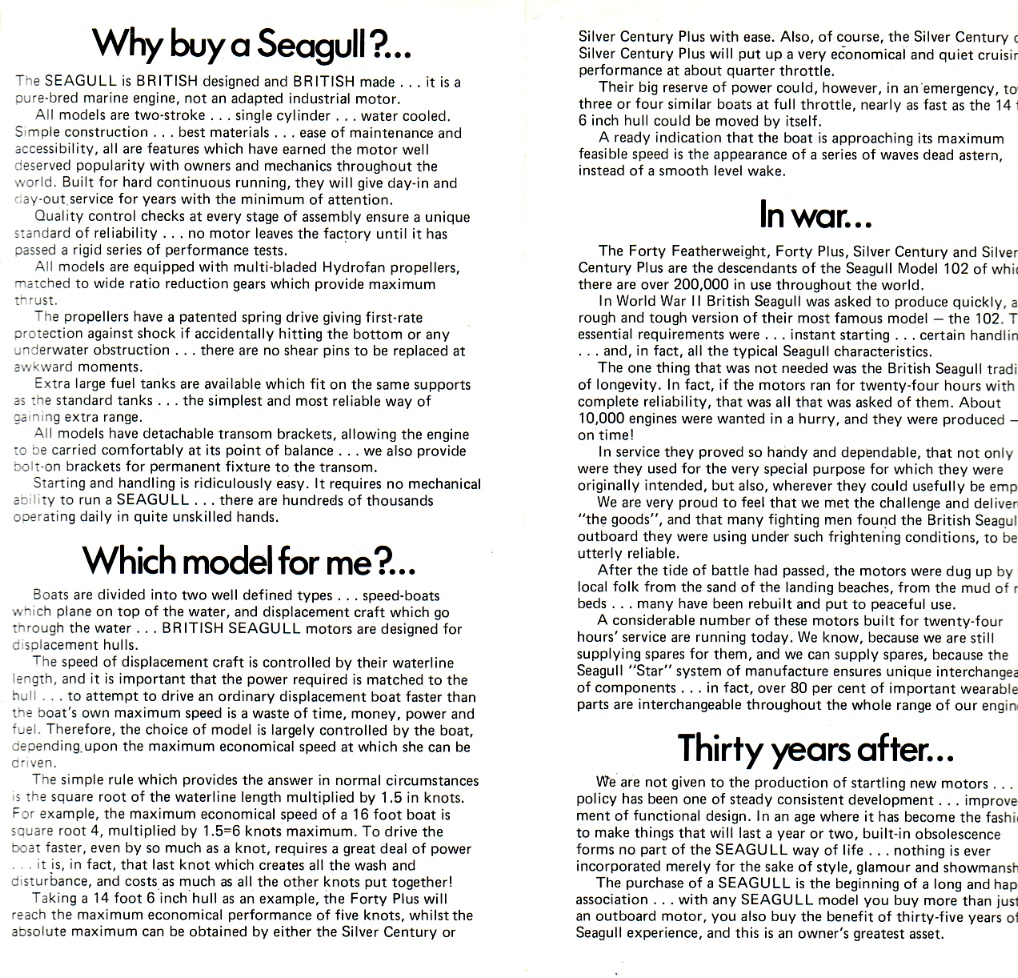
The Seagull was in production for years with loads made in the 1950s, 60's and 70's with the design not changing much over the years. At a conservative estimate well over a million of all types were made and some think 2 million. In the late 70's, when mine was made, Seagull were turning out 80,000 engines a year.

Providing you follow the instructions for stating them they are usually very reliable and invariably start second pull - the important part is to "tickle" the carb float until fuel shows and when cold to remember which way the choke operates and use it. Into the 1970s Cornish inshore fisherman would take their "punts" (largish, heavy wooden dinghies - not what you see at Oxford or Cambridge) out to the difficult waters around the Longships and Wolf Rock with just a Seagull and a pair of oars for propulsion. 
An advert from the 1960s (On the Saving Old Seagulls web site).

Newly painted with a new transfer in the old style from Saving
Old Seagulls. It says use a 10:1 fuel - oil mixture although
this 1976 Mark II 40+ with a Bing carburettor will happily run
without modification at a more normal 25:1. The transfer
is authentic to the original. 
After refitting I found that the fuel tap was leaking fuel like mad, it had held fuel in the tank for 5 years but the cork seal on the "pull for on" tap dried out in less than a week. It is a known problem with a known solution but I didn't expect it to happen so soon. The moving piece with the cork was removed and soaked in hot water (initially boiling hot) for 15 minutes, dried, grease applied and when refitted it worked fine.

The prop stripped and painted, the gearbox etc. just cleaned and
painted.
It is not high tech but it works and similar designs they called the
"Hydrofan" were used on a lot of engines, some larger ones have
5 blades and, despite relatively low power, all can push a
surprisingly heavy boat.

Repaint under way, the fly wheel I did previously
and is still in good condition. The gearbox oil has
been changed as has the gear box plug and the propeller
spring and split pin. The spring (a patented replacement
for a sheer pin) was looking a bit tired so I swapped it
with my spare - they will absorb most shocks but
ultimately will break so a spare is advisable.
Ready to go. The recalcitrant fuel cock
is on the tank bottom left. Note the Bronze
transom mount which is detachable if you
want to leave it in place and carry less,
optional mounts, such as bolt on ones,
were available. 
Note that the flywheel is exposed and there is no recoil starter, health and safety would not be impressed and even if manufacture of 2 stroke outboards was not banned, they could probably not be made now given product liability issues. Also there is no kill cord (it is possible to fit them but hardly anyone does as it can create reliability issues), no twist grip or stop button, you stop the engine by closing the throttle leaver all the way.

Operationally the biggest issue on this model is the lack of a clutch, pull the string and you are off, not a big issue if there is someone to hold onto the mother ship when you are starting but it can require a bit of faith that it will start if you are single handed and there is a strong wind or current. Also you can't turn it through 180 degrees for reverse, probably no bad thing given the whizzing fly wheel.

For anyone tempted they are pretty cheap in this country usually £100 - £150 for a decent runner, but take care there are duff ones out there, many at inflated prices. Good ones, often over restored, can be eye watering expensive overseas and especially in the USA where they are collectors items. In this country things are more generally more relaxed. 

If you want to do significant work on them you will need a few imperial (Whitworth and BSF AF) spanners. Check out the  Saving old Seagulls FAQs and the active Facebook group(s), I follow Seagull Outboard fans | Facebook

For readers with an Achilles 24: Being designed for displacement hulls a 102cc Silver Century (or Century +) with a clutch would appear to be a good option as a prime engine and one that should drive an A24 well, probably better than many modern engines designed for light craft and with nominally more power; but think twice, being in a well you could get a lot of noxious fumes coming into the cockpit even with a 25:1 fuel mix, and they are noisy so not good over long distances, both issues partly due to holes in the exhaust system to reduce back pressure restricting power (and possibly helping the centrifugal water pump).